
The red line corresponds to the RC curve used in the test beam (the result of a calibration performed in-situ on the 4th of August). The dashed black line is from the second in-situ calibration (taken on the 8th of August). The dotted green line is from the pre-test beam characterisation. Generally, both in situ calibrations coincide very well. The small deviation of the pre-test beam result can be explained as a temperature effect. EPS files containing the same plots for all other modules can be downloaded.
The absolute value of the threshold in fC depends on the values of the calibration capacitors and DACs in the ABCD. Deviations from the nominal value have been found in the past. Most importantly, the calibration capacitor depends on the processing of the chips and can vary significantly from one batch/wafer to another. The table below lists the modules in this test beam with the number of the wafer and the factor by which the calibration capacitor (measured on test scructures from the same wafer) deviates from nominal.
Module |
wafer# |
correction factor |
0029 |
Z36459 (Wafer 6) |
1.13 |
0018 |
Z36459 |
1.13? |
0020* |
Z36459 |
1.13 |
0037* |
Z36459 |
1.13 |
0035 |
Z36459 |
1.13 |
0036 |
Z36459 |
1.13 |
K4_218* |
Z36459A |
1.13 |
K4_229 |
Z36459A |
1.13 |
K4_200 |
34685 |
1.07 |
The Japanese modules give very decent (preliminary) median charge values with these corrections.
Results
Noise
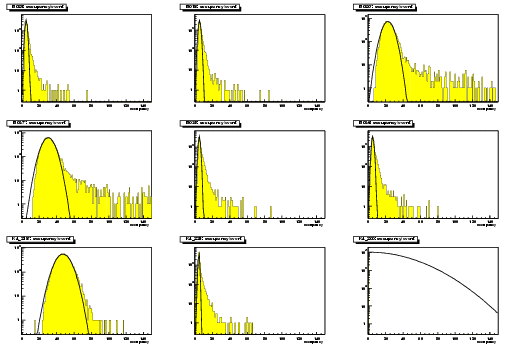
Alan found that in some modules, when operated at the lowest thresholds, very noisy events occur (his web page shows the details). This could be an indication of common mode effects. In order to verify his result I made some plots of the occupancy per event for the first couple of runs. The figure below shows the result for all modules for run 2883 - 0.7 fC threshold.
The links below allow to download EPS files with all plots for one run.
The occupancy due to signal is nominally 2 (both sides of the module are summed in these plots). Hits in all three time bins are summed for all signal evetnts where the reference module was efficient. Noise dominates the occupancy at the lowest thresholds. Random noise results in a Gaussian occupancy distribution. The center of the Gaussian is determined by the threshold level with respect to the noise. Common mode effects will result in a tail towards higher and lower occupancies.
First of all, the center of the distribution is not the same for all modules, whereas the threshold is set to the same value in fC. Noisy (irradiated) modules show distributions that are shifted to higher occupancies (as expected). (common mode) tails are found in all modules. They seem to be largest and most persistent (to higher thresholds) in the irradiated barrel modules. Surprisingly, the forward irradiated module seems to be cleanest.
For comparison with other analyses, I generated some S-curves for a reference set of runs (0 angle, 1.56 T field etc.).
The EPS files can be obtained from this directory
The result is still preliminary. The threshold in all modules has been multiplied by 1.13, to correct for the calibration capacitor. This is correct and yields good results for the Japanese modules. The other modules have been multiplied by the same factor. As soon as their real values become known this will be improved.
During the analysis of the December 2000 test beam at KEK a method was developed to reconstruct the shape of the pulse produced by the ABCD amplifier/shaper. This forms a measurement of the time walk specification and gives some idea of the double pulse resolution. One could even try to infer the time scale of the charge collection in the Silicon, provided a good model of the amplifier/shaper is available. For a description of the results from December 2000 have a look at the web page or the presentation given in the February 2001 SCT week. This year, some interesting runs were taken: runs with the edge sensing circuit switched ON, and runs with the beam pointing to the the W31 sensor of the forward modules.
The basis of the method is a figure of the efficiency as a function of threshold (in fC equivalent charge) and time (reconstructed from the trigger phase measurement of the TDC and the hit pattern from the ABCD).
Efficiency as a function of threshold (horizontal) and time (vertical). The efficiency scale has been multiplied by 1000. K4_200 - runs 3376 to 3391 - 250 V detector bias - perpendicular incidence - no magnetic field - edge sensing circuit inactive.
Same as above - runs 3410 to 3425 - edge sensing ON.
The effect of the edge sensing circuit is very clear. The pulse is cut off after 25 ns - at all threshold levels where the module is efficient.
The pulse shape is obtained from the edge OFF figures like the one above by fitting the efficiency versus threshold with a complementary error function foreach 1 ns time slice. The median charge is taken to be the 50 % efficiency point returned by the fit. If we plot median charge as a function of time we obtain figures like the one below.
Some more pulse shape plots (EPS files)
Some very preliminary conclusions:
The dependence on bias voltage is in qualitative agreement with what was found in the KEK test beam. No significant dependence on magnetic field is found.
One result is quite surprising. The forward (K4) and barrel now give rather similar results, whereas at KEK the forward (K3) modules had consistently slower pulses than the barrel modules. The position of the beam in the near (W31) or far (W32) wafer in the forward modules - which was proposed as an explanation for the no longer existent difference between barrel and forward modules - has no significant effect.
Irradiated modules again have significantly slower pulses than their non-irradiated partners.
A more quantitative analysis and comparison with the KEK results is necessary.
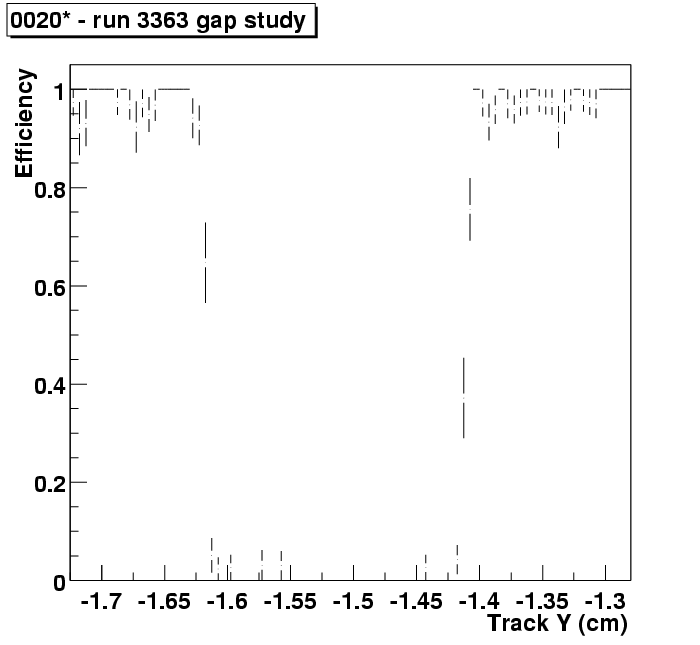
One of the goals of the August 2001 test beam was to study the response of the edges and corners of the detector. While most runs of this programme were taken with difficult beams and have not been processed yet, runs 3360 and following can be used for a study of the gap between both wafers. The figures below show efficiency as a function of the Y coordenate of the extrapolated track. The bin size is 50 micron in this case, ie the efficiency falls from nearly 1 to 0 in less than 100 microns. No difference is observed between the non-irradiated and irradiated module.
The tracks are bent on their passage through the 1.56 Tesla field inside the Morpurgo magnet. In normal test beam analyses this effect is absorbed in the alignment parameters (the alignment is done on data with field ON). By analysing a run with field ON with a previous alignment without field (hoping that the alignment is not affected too much by switching on the magnet) one can see the effect of the field on the tracks.
The figure shows the displacement of the residuals in all modules and telescope planes measuring X (the direction of the bend). X=0 is set to be the position of the second telescope pair (at Z=100). A fit with a cirle gives a value for either the beam energy or the magnetic field strength. The errors in X and Z were set (rather arbitrarily) to be 30 microns and 1 cm respectively. If anyone is interested in trying to do a real measurement along these lines, let me know.
S curves
Pulse shapes


Gap Study

Effects of the magnetic field

 Last
update November 10, 2000
Last
update November 10, 2000
Marcel.Vos@ific.uv.es,